Indoor Air Quality
Local Experts Serving Broward & Miami-Dade
South Florida's humidity, pollen, and salt air make indoor air quality a real concern for many families. Martin's Family Cooling offers complete indoor air quality solutions across Broward and Miami-Dade County — from high-efficiency filtration to UV lights, dehumidifiers, and duct cleaning — helping you breathe cleaner, healthier air at home.
This page explains the indoor air quality challenges we face in South Florida, the solutions we offer, how to choose the right approach, and how IAQ connects to your overall comfort. You can also explore our AC maintenance services or our ductwork services for related improvements.
Why Indoor Air Quality Matters in South Florida
Indoor air quality in South Florida is shaped by our climate more than most people realize. High humidity encourages mold, dust mites, and mildew. Pollen is a year-round issue. And near the coast, salt air affects both outdoor equipment and indoor air. Your air conditioner doesn't just lower temperature — it removes moisture from the air, and that dehumidification is a big part of what makes a home feel comfortable and healthy.
When a system is oversized, poorly maintained, or short-cycles, it may cool the space without running long enough to remove humidity, leaving the air cool but clammy and encouraging mold and dust mites. Addressing the root cause — airflow, refrigerant charge, drainage, or system sizing — is more effective than masking odors. Read more in our article on indoor air quality, humidity, and mold in Florida homes.
Common Indoor Air Quality Problems
Several IAQ issues are common in South Florida homes, most tied to humidity, biological growth, or contaminants circulating through the system. Recognizing them helps you choose the right solution rather than treating symptoms.
- High indoor humidity that encourages mold, mildew, and dust mites.
- Mold and biological growth at the coil or in the ducts, from constant moisture.
- Allergens and pollen circulating through the system.
- Dust and debris accumulated in ductwork over years of operation.
- Odors from the air handler or ducts, often a sign of moisture or contamination.
- Stale air in tightly sealed homes with limited fresh air exchange.
Our Indoor Air Quality Solutions
We offer a complete range of IAQ solutions, each addressing a specific concern. The right combination depends on your home, your occupants, and how your system is currently performing — and we tailor recommendations rather than applying a one-size-fits-all package.
- Air Quality Testing — identify pollutants, humidity levels, and specific concerns in your home.
- High-Efficiency Filtration — upgraded filters and whole-home solutions to capture dust, pollen, and allergens.
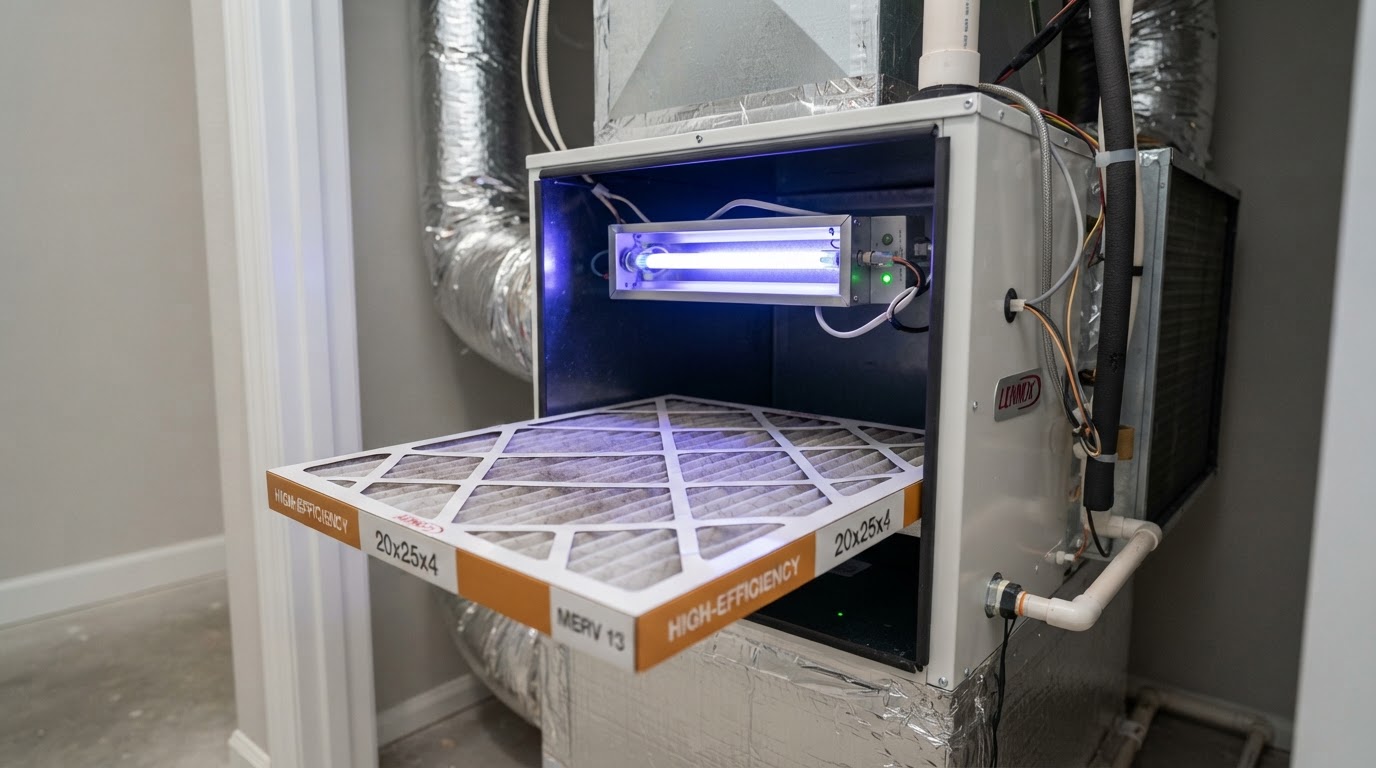
- UV Germicidal Lights — installed at the coil to kill mold, bacteria, and viruses where they grow.
- Whole-Home Dehumidifiers — control persistent humidity for comfort, health, and mold prevention.
- Air Purifiers — whole-home purification to remove contaminants from circulating air.
- Duct Cleaning — remove accumulated dust, debris, and biological growth from your ductwork.
Benefits of Improved Indoor Air Quality
Better indoor air quality delivers health, comfort, and efficiency benefits that compound over time. Cleaner air reduces allergy and asthma triggers, controlled humidity prevents mold and protects your home, and a well-functioning system runs more efficiently — lowering bills while improving comfort.
- Healthier indoor air with fewer allergens and contaminants.
- Reduced allergy and asthma triggers for sensitive occupants.
- Better humidity control, preventing mold and mildew.
- Less dust and cleaner surfaces throughout the home.
- Improved comfort and often lower energy bills from a more efficient system.
Choosing the Right IAQ Solution
The right IAQ approach depends on your specific concerns. For persistent humidity, a whole-home dehumidifier may be the answer. For allergies, high-efficiency filtration and UV lights often help. For odors or visible contamination, duct cleaning combined with UV at the coil addresses the source. We start with testing and assessment to identify your actual issues, then recommend the solutions that will genuinely help — rather than selling a generic package. Our indoor air quality article covers these options in more depth.
How the IAQ Process Works
Improving your indoor air quality starts with understanding what's in your air. Here's what to expect.
- Assessment — we evaluate your home, system, and specific IAQ concerns, often including testing.
- Recommendation — we recommend the solutions that address your actual issues.
- Upfront quote — we price the recommended work before anything begins.
- Installation & verification — we install the equipment and confirm improved performance.
IAQ and Your HVAC System
Indoor air quality and HVAC performance are tightly linked. A properly sized, well-maintained system dehumidifies effectively and filters air as it runs. An oversized or neglected system may cool without dehumidifying, leaving air clammy and encouraging mold. That's why IAQ improvements often pair with AC maintenance and, when needed, ductwork sealing — addressing the system alongside the air it moves. Our Family Comfort Plan helps keep your system performing its best for healthier air.
Why Martin's Family Cooling
Our family-owned team takes a tailored, honest approach to indoor air quality — identifying your actual concerns and recommending solutions that genuinely help. We're licensed and insured, our technicians are background-checked, and we install and service all major IAQ equipment. We quote upfront, recommend only what's needed, and help your family breathe easier.
- Tailored recommendations based on testing and assessment.
- Complete IAQ solutions — filtration, UV, dehumidifiers, purifiers, and duct cleaning.
- Licensed, insured, and background-checked technicians.
- Upfront pricing and honest advice.
- Integration with your HVAC system for whole-home results.
Understanding Humidity and Comfort
In South Florida, humidity is as important to comfort as temperature — sometimes more so. The human body cools itself through evaporation, and high humidity slows that process, making a room feel warmer and less comfortable than the thermostat suggests. Your air conditioner removes moisture from the air as it cools, and that dehumidification is a big part of what makes a home feel comfortable. When a system is oversized, poorly maintained, or short-cycles, it may cool the space without running long enough to remove humidity, leaving air cool but clammy.
Ideal indoor humidity is generally between 30% and 50%. Above that, mold, dust mites, and discomfort increase; below that, air can feel dry and irritating. In South Florida, maintaining that range often requires more than the AC alone can provide, especially during the humid season. A whole-home dehumidifier can supplement your system's dehumidification, and proper system sizing and maintenance ensure your AC dehumidifies effectively. Read more in our indoor air quality article.
- Humidity affects comfort as much as temperature in South Florida.
- Your AC dehumidifies as it cools, but oversized systems may not run long enough.
- Ideal indoor humidity is 30–50%.
- High humidity encourages mold, dust mites, and discomfort.
- A whole-home dehumidifier can supplement your AC's dehumidification.
Filtration: Your First Line of Defense
Air filtration is the foundation of indoor air quality, capturing dust, pollen, pet dander, and other particles before they circulate through your home. Standard filters catch larger particles but let smaller ones through; high-efficiency filters capture far more, including many allergens and fine particles. Upgrading your filtration is often one of the most effective and affordable IAQ improvements available, and it's integrated with your existing HVAC system.
Filter choice involves a balance between filtration effectiveness and airflow. Higher-efficiency filters (higher MERV ratings) capture more but can restrict airflow if your system isn't designed for them, potentially reducing efficiency or causing problems. We help you choose a filter that improves air quality without compromising system performance, and we ensure your system can handle the upgrade. For severe allergies or asthma, we may recommend additional solutions like UV lights or whole-home purifiers. Learn about maintenance on our AC maintenance page.
- Standard filters catch larger particles; high-efficiency filters capture more.
- Upgrading filtration is an affordable, effective IAQ improvement.
- Higher MERV filters capture more but can restrict airflow.
- We ensure your system can handle the filter you choose.
- For severe allergies, UV lights or purifiers may complement filtration.
UV Germicidal Lights
UV germicidal lights are installed at the evaporator coil to kill mold, bacteria, viruses, and other microorganisms where they tend to grow. In South Florida's humid climate, the indoor coil is a common site for biological growth, which can reduce efficiency, cause odors, and circulate contaminants through your home. A UV light installed at the coil neutralizes that growth, keeping the coil clean and the air healthier. UV lights are a proven, low-maintenance IAQ solution that complements filtration.
UV lights work continuously when the system runs, providing ongoing protection at the coil. They don't replace filtration — which captures particles — but they address the biological growth that filtration alone can't prevent. For homes with mold concerns, allergies, or persistent odors, UV lights are often a worthwhile addition. We install and service UV systems as part of our comprehensive IAQ offerings, integrating them with your existing equipment. See our indoor air quality article for more.
Whole-Home Dehumidifiers
When your AC alone can't keep humidity in a comfortable range, a whole-home dehumidifier provides dedicated moisture removal. Integrated with your HVAC system, a whole-home dehumidifier pulls excess moisture from the air, maintaining the 30–50% humidity range that feels comfortable and discourages mold. This is especially valuable in South Florida during the humid season, when even a well-functioning AC may struggle to keep up with moisture levels.
A dehumidifier also lets you set your thermostat a degree or two higher without sacrificing comfort, since lower humidity makes the air feel cooler — saving energy. For homes with persistent humidity, musty odors, or mold concerns, a dehumidifier is often the most effective solution. We assess whether a dehumidifier is the right addition for your home and install units integrated with your system for whole-home results. Combined with proper AC maintenance, it delivers lasting comfort and healthier air.
- Provides dedicated moisture removal when AC alone isn't enough.
- Maintains the 30–50% humidity range for comfort and mold prevention.
- Lets you set the thermostat higher without sacrificing comfort, saving energy.
- Especially valuable during South Florida's humid season.
- Integrated with your HVAC system for whole-home results.
Duct Cleaning and When It Helps
Duct cleaning removes accumulated dust, debris, and biological growth from your ductwork, and it can improve air quality when contamination is significant. Over years of operation, ducts can collect dust, pollen, mold spores, and debris, especially if filters haven't been effective or the system has had moisture issues. Cleaning removes that buildup so it stops circulating through your home. However, duct cleaning isn't needed in every home — it's most valuable when there's visible contamination, persistent dust, mold, or after construction or renovation.
We assess whether duct cleaning is warranted rather than recommending it routinely. When it is, we combine it with related solutions — sealing leaks, addressing moisture sources, and upgrading filtration — so the improvement lasts. Cleaning alone, without addressing the underlying causes of contamination, provides only temporary relief. For a comprehensive approach, see how duct cleaning fits with our ductwork services and indoor air quality solutions.
Air Purifiers and Whole-Home Purification
Whole-home air purifiers provide a higher level of contaminant removal than standard filtration, capturing particles and sometimes gases and odors that filters alone miss. Integrated with your HVAC system, a whole-home purifier treats all the air circulating through your home, addressing allergens, fine particles, and volatile organic compounds (VOCs) that can affect health and comfort. For homes with severe allergies, asthma, or chemical sensitivities, a whole-home purifier can be a valuable addition to the IAQ strategy.
Different purifier technologies address different concerns: HEPA-based systems capture extremely fine particles; activated carbon addresses gases and odors; electronic air cleaners charge particles to capture them. We help you choose based on your specific concerns, integrating the right technology with your system. Like all our IAQ solutions, we recommend purification when it genuinely addresses a verified need, rather than as a generic add-on. See our indoor air quality article for more on these technologies.
- Whole-home purifiers capture particles, gases, and odors filters may miss.
- They treat all air circulating through your HVAC system.
- HEPA captures fine particles; activated carbon addresses gases and odors.
- Especially valuable for severe allergies, asthma, or chemical sensitivities.
- We recommend purification when it genuinely addresses a verified need.
Building a Complete IAQ Strategy
Effective indoor air quality improvement usually involves a combination of solutions working together, tailored to your home's specific concerns. Filtration is the foundation, capturing particles throughout your home. UV lights address biological growth at the coil. A dehumidifier controls persistent humidity. Duct sealing prevents contaminants from entering through leaks. And duct cleaning removes accumulated buildup when warranted. The right combination depends on what testing and assessment reveal about your air.
We take a holistic approach, starting with assessment to identify your actual concerns and recommending the combination of solutions that will genuinely help. We don't apply a one-size-fits-all package or sell equipment you don't need. Instead, we build a strategy that addresses your home's specific IAQ challenges, integrated with your HVAC system for whole-home results. Proper AC maintenance and ductwork condition are part of that strategy, ensuring the system that moves your air is itself clean and efficient.
- Effective IAQ improvement combines filtration, UV, dehumidification, and sealing.
- The right combination depends on what assessment reveals about your air.
- We start with testing to identify actual concerns, not generic assumptions.
- We build a tailored strategy, not a one-size-fits-all package.
- System maintenance and duct condition are part of a complete IAQ strategy.
Indoor Air Quality and South Florida's Climate
South Florida's climate creates specific indoor air quality challenges that make IAQ solutions particularly valuable here. Our high humidity — often above 60% outdoors — drives moisture indoors, where it promotes mold and mildew growth, dust mite populations, and a generally damp environment that feels uncomfortable and can affect health. The long cooling season means windows stay closed most of the year, trapping indoor pollutants with no natural ventilation to clear them. And our pollen seasons, while different from northern climates, still affect allergy sufferers indoors.
This combination makes dehumidification, filtration, and biological control especially important in South Florida homes. A whole-home approach — controlling humidity, filtering particles, and preventing biological growth at the coil — addresses the climate-specific challenges we face. For homes with allergy sufferers, asthma, or mold concerns, IAQ solutions can dramatically improve daily comfort and health. We assess your home's specific IAQ challenges and recommend solutions tailored to our climate. Read more in our indoor air quality article.
- High humidity drives moisture indoors, promoting mold and dust mites.
- The long cooling season traps indoor pollutants without natural ventilation.
- Dehumidification, filtration, and biological control are especially valuable here.
- IAQ solutions can dramatically improve comfort for allergy and asthma sufferers.
- We assess climate-specific IAQ challenges and recommend tailored solutions.
Frequently Asked Questions
These are questions customers ask about indoor air quality. The full FAQ set appears below.